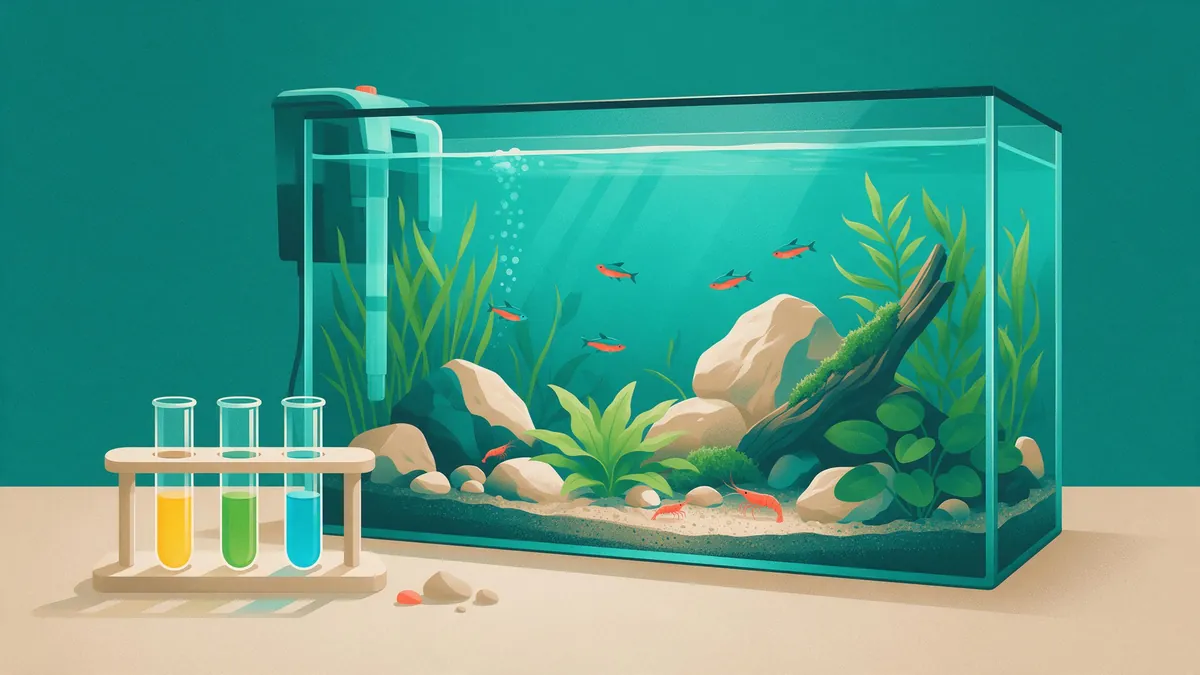
Cycling grows the bacteria that turn toxic fish waste into safer nitrate. Feed a new tank ammonia (fishless) or a little fish food with a few hardy fish (fish-in), test every day or two, and wait until it reads 0 ammonia and 0 nitrite with some nitrate. That usually takes 4 to 8 weeks.
Two ways to cycle
FishlessBest choice. No fish at risk, 4–6 weeks. You dose ammonia yourself.
Fish-inIf fish are already in the tank. 5–9 weeks of daily tests and water changes.
Fishless cycle, step by step
- Set up and dechlorinate. Filter and heater running, tap water treated with conditioner.
- Dose ammonia to 2 ppm. Use pure ammonia with no soap or scent, a little at a time, testing as you go.
- Test every 2–3 days. Ammonia falls, nitrite appears, then nitrate. Re-dose to 2 ppm whenever ammonia hits 0.
- Watch for the finish. 2 ppm ammonia becomes 0 ammonia and 0 nitrite within 24 hours, two days in a row, with nitrate present.
- Water change, then fish. Change about 75% of the water to lower nitrate, then add a few fish.
Fish-in cycle: keep them safe
Test ammonia and nitrite every day. At 0.25 ppm of either, change 30–50% of the water and feed less. At 1 ppm, change water right away. Feed once a day, lightly, and add no more fish until the numbers read 0.
When will your cycle finish?Open the calculator →Questions
Can I speed up cycling?
Keep the water around 80°F, add bottled nitrifying bacteria or a used filter sponge from a healthy tank, and don't clean the filter. Test to confirm; bottles don't always work.
My nitrite reading has been stuck for weeks. What now?
Very high nitrite (above 5 ppm) can stall the bacteria. Change 50% of the water, keep dosing ammonia to 2 ppm, and keep testing.
Do I need to cycle a tank for a betta?
Yes. Every tank with a filter needs a cycle, whatever its size or fish.
General information, not veterinary advice. Updated November 2026.